TECHNICAL ANALYSIS FOR BEGINNERS

Technical Analysis for Beginners blog post. Introduction: Welcome to the world of technical analysis – where price talks and we learn to listen. Section 1 – Support and Resistance, Think of Bouncing Balls: Support is a price level where a stock tends to stop falling because buyers step in. Resistance is where it tends to stop rising because sellers take profits. Example: If TATA Motors keeps falling but bounces back every time it hits ₹600, that is your support. If it keeps rising but reverses around ₹750, that is your resistance. Tip: The more times the price touches these levels and reverses, the stronger they become. Section 2 – RSI, Is the Stock Too Hot or Too Cold: RSI (Relative Strength Index) measures momentum. RSI above 70 means overbought (possible pause or correction). RSI below 30 means oversold (possible bounce). Example: If Tata Motors falls sharply and RSI drops to 25, it signals selling pressure may be over – a bounce could be near. Think of RSI as the stock's energy meter.
Section 3: MACD (Moving Average Convergence Divergence). MACD uses two lines to show momentum – how fast price is speeding up or slowing down. When the MACD line crosses above the signal line = Buy signal. When it crosses below = Sell signal. Bonus: MACD also shows histograms (bars) that help visualize momentum. Mistake to avoid: Don't use RSI or MACD alone. Use them with support/resistance and trend direction for best results. Section 4: Other Handy Indicators (Use Smartly, Not Excessively). Once you understand support, resistance, RSI, and MACD, you can slowly explore a few more indicators. These tools support your decision — they don't replace thinking. Moving Averages (20, 50, 200 DMA): Help identify the overall trend. Price above moving average = bullish bias; Price below moving average = bearish bias. Example: If a stock is consistently trading above its 50-day moving average, it usually indicates strength. Volume: Tells you whether a price move is reliable or weak. Rising price plus high volume = strong move; Rising price plus low volume = risky move. Example: A breakout with strong volume has a higher chance of sustaining. Bollinger Bands: Show volatility and price extremes. Price near upper band = stock may be overextended; Price near lower band = possible reversal zone. Example: When price touches the lower band and RSI is oversold, traders watch for a bounce.
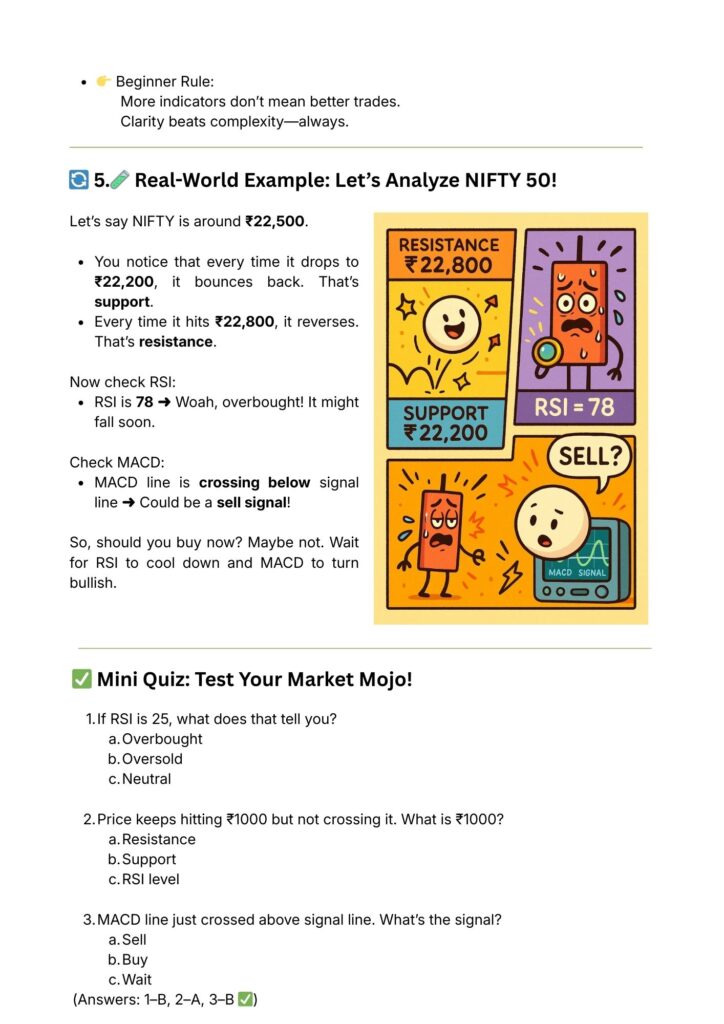
Cartoon illustration of a NIFTY 50 technical analysis example showing Resistance at ₹22,800, Support at ₹22,200, RSI equals 78, and a Sell signal from MACD.
Final Tips for You, Rookie Analyst: Combine multiple indicators – don't rely on just one. Always look at bigger trends – don't zoom in too much. Practice on demo charts before using real money. Avoid emotional decisions – indicators over gut feelings. Stay calm – no FOMO! Zoom out for big picture! Feeling more confident now? Technical analysis is like learning a new language – once you get the basics, you'll see what the market's trying to tell you. Parashuram Desai, SEBI Reg. Research Analyst, 9405732104, alphastocks.co.in

Parashuram Desai,
SEBI Registered Research Analyst, Registration no. INH000019415

Follow Us

Scroll to Top